My Stories

7 stories

A snow fort glowing with blue light, winter 1956
Concord, Massachusetts, winter 1956

The Blue Light in the Snow Fort

winter 1956, Vermont

But he wasn't the one inside it looking at the blue light.

So I was thinking about this all morning, what to even say. And then I looked out the window and it's snowing, just a little, not real snow. And it took me right back to the winter of 56. I would have been eight, eight years old. Tommy was 10. We had this blizzard, I mean a real nor'easter, the kind where you can't see the Henderson's house across the street, and that's maybe 40 feet away. School was canceled for three days, which, you know, when you're eight, that's basically a lifetime.

And my mother, she was not the kind of woman who liked having children inside. She bundled us up and sent us out. I had these red mittens that my grandmother had knitted me, the wool ones that got heavy when they got wet. And Tommy had this ridiculous hat with ear flaps that made him look like a beagle.

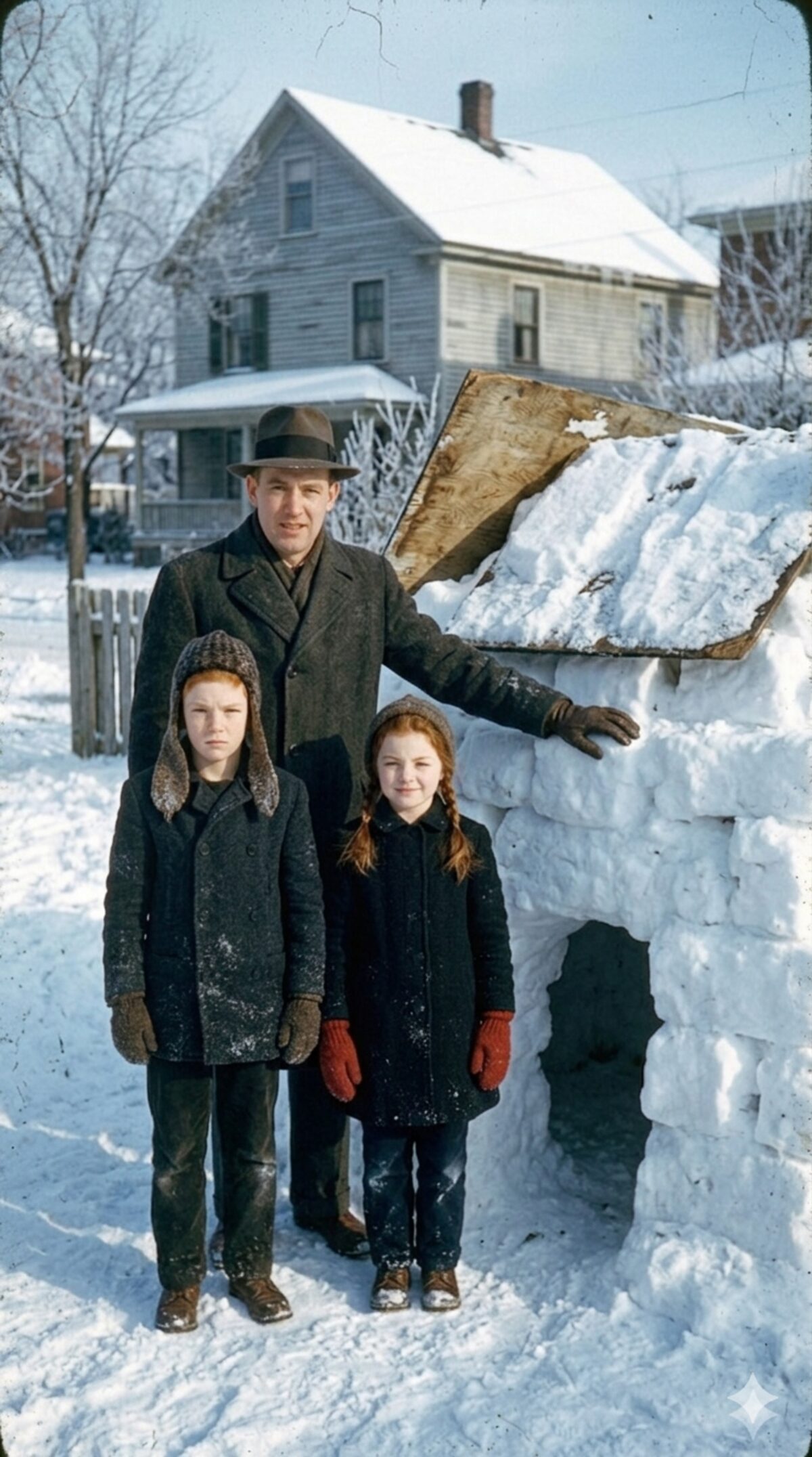
We built a snow fort in the backyard. And I don't mean, you know, a little pile. Tommy was very serious about it. He'd seen something in a book about igloos, and he decided we were building one. We spent, oh I think, two full days on it. My father came out on Saturday and helped us shore up the roof. He used a piece of plywood and then we packed snow on top so you couldn't see it. He worked at Raytheon, my father, did something with โ€” I never really understood what he did, actually. Defense contracts, he couldn't talk about it. But a snow fort, that he could build. He got more into it than we did.

My mother took a photo of the three of us in front of it, but I don't know where that photo ended up. Probably in one of the boxes in the attic. Sarah keeps saying she'll go through those boxes with me, but you know, we never do.

Anyway, the thing I remember most is the light inside. Once we crawled in and sort of packed the entrance a little smaller, the snow walls had this blue glow like being inside a lantern. Tommy had stolen, well, borrowed, a candle from the dining room, and we lit it in there, which I'm sure was a terrible idea. But the light on the snow walls was, I still think about it, this blue and gold.

We stayed in that fort until my mother came out banging on a pot with a wooden spoon. That was her system. She never yelled for us. She just banged a pot. The whole neighborhood knew when the Sullivan kids were being called in. She made cocoa with too many marshmallows, always too many marshmallows. And I would burn my tongue every time because Tommy and I had this โ€” wait, what was I going to say about โ€” oh, the marshmallows, right. We had this race to see who could drink it before they melted. And I always lost. I was never patient. Harold was the patient one. He would, hmm, I'll talk about Harold another time.

But that kitchen, I can still feel the radiator against my back. We used to sit on the floor and lean against it after we came inside. Tommy lives in Vermont now. We talk every Sunday. He'll say I'm making this all up, that the fort was much smaller than I remember. But he wasn't the one inside it looking at the blue light. So, anyway.
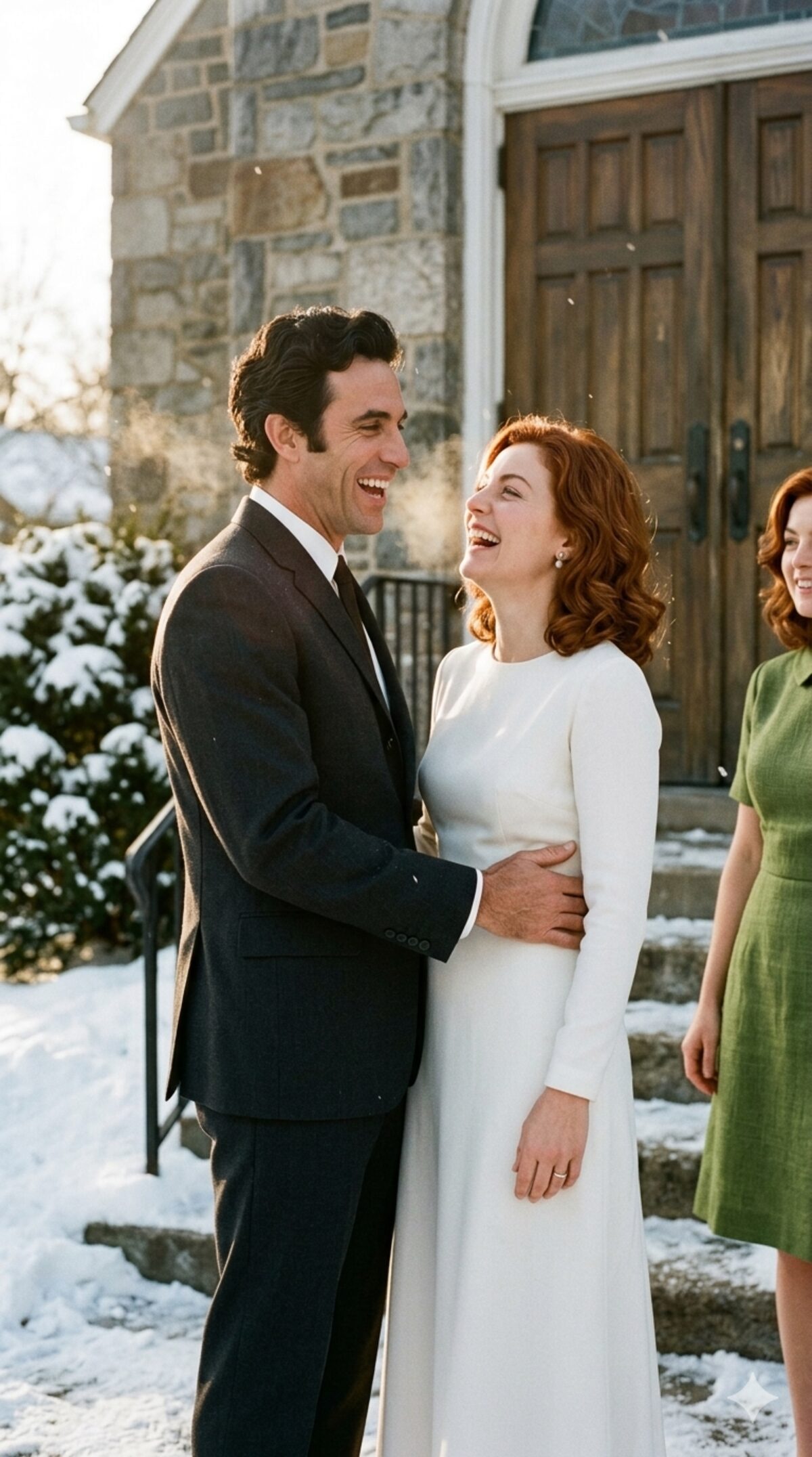
A young couple at a community center dance, 1968
Concord, October 1968

The Dance on Thoreau Street

October 1968 โ€“ January 1970, Walden Street

Who is this man? He works at a lumber yard and he talks about pancakes and he watches rivers.

Oh, I have a good one today. So Sarah, my daughter, she's the one who set this whole thing up. She called me last night and she said, Mom, tell them how you met Dad. And I said, Sarah, that's such a cliche. And she said, Mom, just tell it. So fine, fine.

It was 1968, October. I know it was October because Betty, my friend Betty Kowalski, she was my roommate. We shared an apartment on Walden Street. Betty had just had her birthday and she wanted to go dancing. There was this thing at the community center on Thoreau Street, a Saturday night dance. They used to do them once a month. Live band, usually pretty bad. We were 20, which felt very grown up at the time. I can tell you it does not feel grown up looking back. Betty spent, I don't know, an hour on my Harold that evening. She had this whole system with rollers and hairspray. Her bathroom smelled like a salon. And she lent me her green dress, the one with the little collar, because I didn't have anything right, and she said, Maggie, you cannot wear a cardigan to a dance. I still had my mother's clip-on earrings, the pearl ones. I'd taken them when I moved out. I don't think she ever noticed. Sorry, Mom. And Betty said I looked like Audrey Hepburn, which was a lie, but a nice lie.

So we get there, and it's the usual crowd. And Betty immediately goes off to talk to, I think his name was Phil. She had a whole Phil situation that fall. I won't get into it. And I'm standing by the punch bowl. There was always a punch bowl. This was 1968, not, you know, anyway. I'm standing there feeling a bit ridiculous in Betty's dress because it was tighter than what I'd normally wear. And this man walks up to me. And the first thing I notice is his shirt because it's this green and brown plaid flannel tucked into these gray slacks. And the combination is just, it's terrible. And he says, would you like to dance? Very serious, like he's asking me to sign a legal document. And I should have said no because I could tell just from the way he was standing that he had no idea what he was doing. But something about โ€” he had these very calm eyes, brown eyes, and these long eyelashes, which always seemed unfair to me, a man having those eyelashes. So I said, OK.

The band was playing โ€” oh, what was it? It was something by the Everly Brothers, I think. Or maybe it was, no. You know what? It might have been Unchained Melody. I used to be so sure about this, and now I'm not. Harold always said it was the Everly Brothers, and I always said it wasn't. And we had this argument for 50 years, and neither of us ever won. So we're dancing, and he steps on my foot, my left foot, and then my right foot. And I said, and I'm not proud of this, Betty would have killed me, she always said I had no filter โ€” I said, are you trying to dance with me or arrest me? Which is a terrible thing to say to someone you just met. But he laughed. He just, he tipped his head back and laughed. And his hand kind of tightened on my waist a little. Not in a โ€” just, you know. And he said, I'm sorry, I really only know how to do this in my kitchen.

After that song, we went outside. It was cold, real October cold. And he gave me his jacket, the terrible flannel. And I remember thinking I probably shouldn't take it, that it meant something to take a man's jacket. But I was freezing in Betty's dress, so I did. And it smelled like sawdust and something else, soap maybe. He worked at Barrett's Lumber on Route 2. I found that out later. We just walked. We walked around the block and then around again and Betty was inside probably wondering where I'd gone and I didn't care. He told me about, actually this is funny, the first real thing he told me about was his mother's pancakes. This blueberry pancake recipe she had. He was very passionate about these pancakes. I thought, this is either a very strange man or a very honest one. We were married 14 months later, January 1970 at St. Bernard's, wicked cold. But I'm skipping. I do this. I jump to the ending. Let me go back.

We walked for, I don't know, maybe two hours. He walked me home the long way, down Monument Street past the old North Bridge, which you would never do. It's completely out of the way. But neither of us said anything about it. We just kept walking. And at some point I realized my hands were shaking. Not from the cold, just, I don't know. I put them in the jacket pockets so he wouldn't see. And there was a moment. I forgot about this until just now. We were passing the bridge and he stopped and looked at the river. And he said something about how the water looks black at night, but if you wait, your eyes adjust and you can see it moving. And I thought, who is this man? He works at a lumber yard and he talks about pancakes and he watches rivers. I knew by the end of that walk. I don't know how else to say it. I just knew.

Tommy said I came home looking like I'd been hit by a bus, and I said, Tommy, I think I have been. I called Betty the second I got in. She picked up on the first ring. She'd been waiting. She was furious I disappeared. I told her everything, and she kept saying, the lumberyard guy? The plaid shirt guy? And I said, Betty? I'm going to marry him. And she said, Maggie, you've known him three hours. And I said, I know. Betty was my maid of honor. She wore the green dress. His shirt was better.


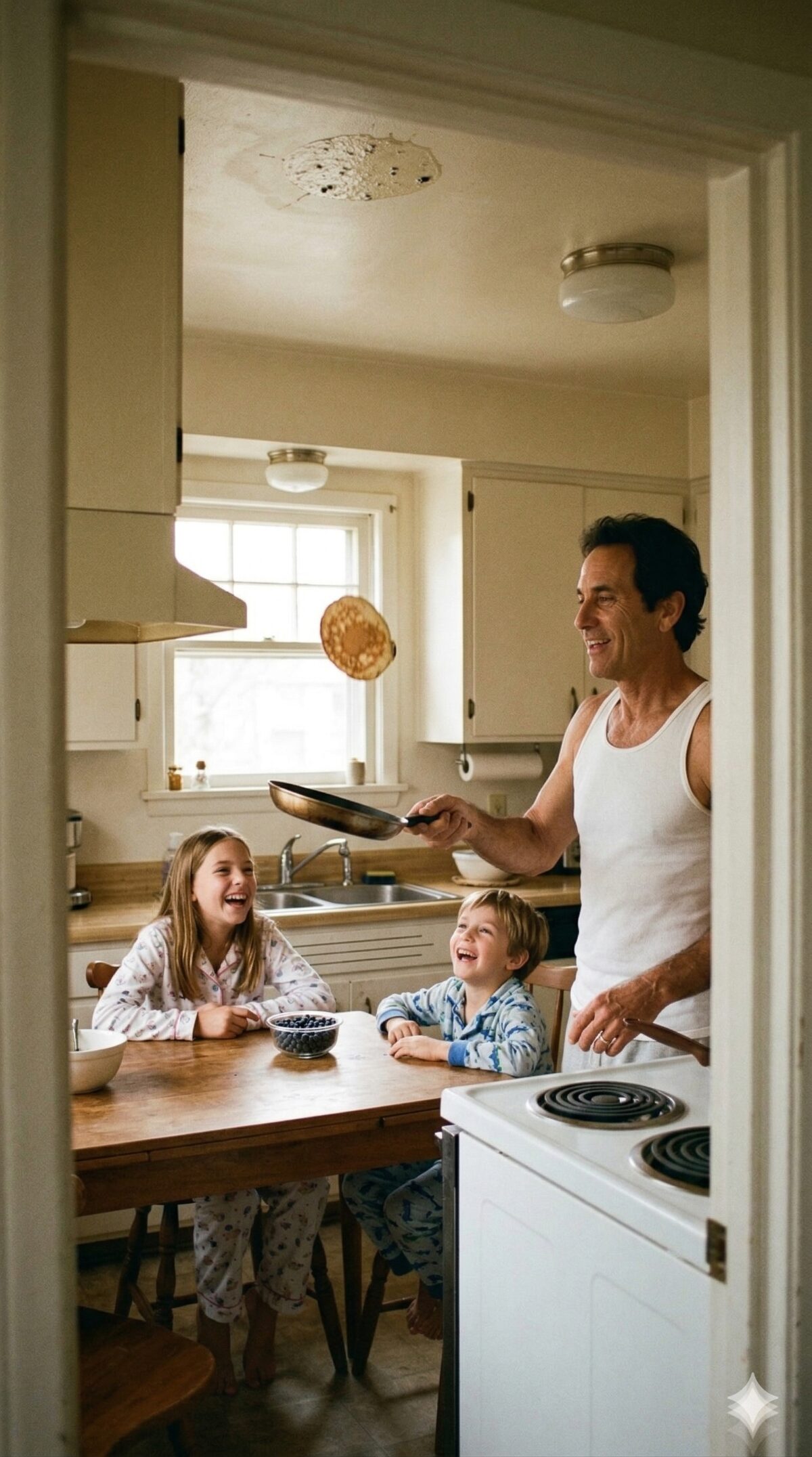
Sunday morning pancakes in a warm kitchen
The Brennan kitchen, Sunday morning

The Blueberry Stain on the Ceiling

1969โ€“2025, Nashua

The kitchen is just, it's very quiet when I make them. That's the thing I keep noticing, how quiet it is.

Okay, so I have to tell you about the pancakes because I mentioned them last time and then didn't. I do that. Harold used to say, I tell stories like I'm taking a detour through six different towns to get to the grocery store. So, Harold made blueberry pancakes every Sunday morning, every single Sunday morning for โ€” well, from before we were married, really, because he made them for me that first time I came to his mother's house for dinner, which was actually a lunch. Grace always called lunch dinner and dinner supper. It was a whole โ€” anyway, that would have been early 69. So from 69 until, well, three years ago, that's over 50 years of Sunday pancakes.

The recipe was Grace's, his mother. She was this tiny, tiny woman from New Hampshire, barely five feet. And she had this kitchen in her house in Nashua that was smaller than my bathroom. And somehow out of that kitchen came these pancakes that were just, I don't have the word. They weren't fancy. Blueberries, buttermilk, a little bit of lemon zest, which I didn't know about until years later when I watched her actually make them. She never wrote the recipe down. Harold never wrote it down either. He said he just knew. He'd just pour and he'd know when to stop.

The ritual was, okay, Sunday morning. I'd wake up because of the smell. Not the pancakes yet, the butter in the pan. He used an obscene amount of butter, which my doctor would not have approved of. And then the blueberries. When they hit the hot batter, they kind of pop, and there's this sweet, it just fills the whole downstairs. The kids would come down in their pajamas. Sarah always first, David five minutes later, because David was never on time for anything in his life. Still isn't.

And Harold would flip them. He had this move. He wouldn't use a spatula. He'd flip them in the pan like on TV, you know? And he flipped too hard, every time. One time, and the kids will not let this go, they bring it up every Thanksgiving. One time a pancake hit the ceiling, stuck there. Little blueberry stain on the ceiling. We painted over it twice and you could still see it. We sold the house in, wait, no, we didn't sell that house. We're in the same house. The stain is still there. I look at it sometimes. And he hummed while he cooked. I don't know if he knew he did it. It wasn't a song exactly, just this mmm, mmm, mmm, low and steady while he moved around the kitchen. I asked him once what he was humming, and he looked at me like I was crazy. He said, I'm not humming. He absolutely was.

So that was Sunday, every Sunday for 50 years. After he โ€” I tried to make them. After. Of course I did. I'd watched him do it a thousand times. How hard could it be? And they were fine. They were pancakes. They tasted like pancakes. The kids said they were great. Sarah said, Mom, these are great. But I could tell. Something was off. The blueberries didn't pop the same way. The batter was, I don't know, too thick or too thin. I could never get it right. I tried maybe 30 times that first year. Different amounts of buttermilk, more lemon zest, less lemon zest. I called Grace's neighbor, Mrs. DiMaggio. Grace had been gone since 94. I don't even know why I thought she'd know. I was just, I was grasping, I suppose. And she said, no, honey, Grace just made them. I don't know what's different. I really don't. I've done everything the same. I use the same bowl, the same pan. The kitchen is just, it's very quiet when I make them. That's the thing I keep noticing, how quiet it is.

David came for a visit last April. He was supposed to come in March, but Lily had something with her school, a recital or a, no, it was a science fair, I think. She built a volcano. Or was that Jack? One of the grandchildren built a volcano. Anyway, he came in April and he made pancakes, and they were different again. Not Harold's, not mine. David's. He put on music on his phone. That little speaker thing Emma got him. And the kids liked them. Lily said, these are the best pancakes. And David looked at me and I looked at him and we didn't say anything.

So there's no recipe. That's what I'm telling you. People ask me for the recipe and I say, I don't have one. And they think I'm being, I don't know, precious about it. I'm not. There just isn't one. I tried. Anyway, David said he'll make them next time he visits. He better.


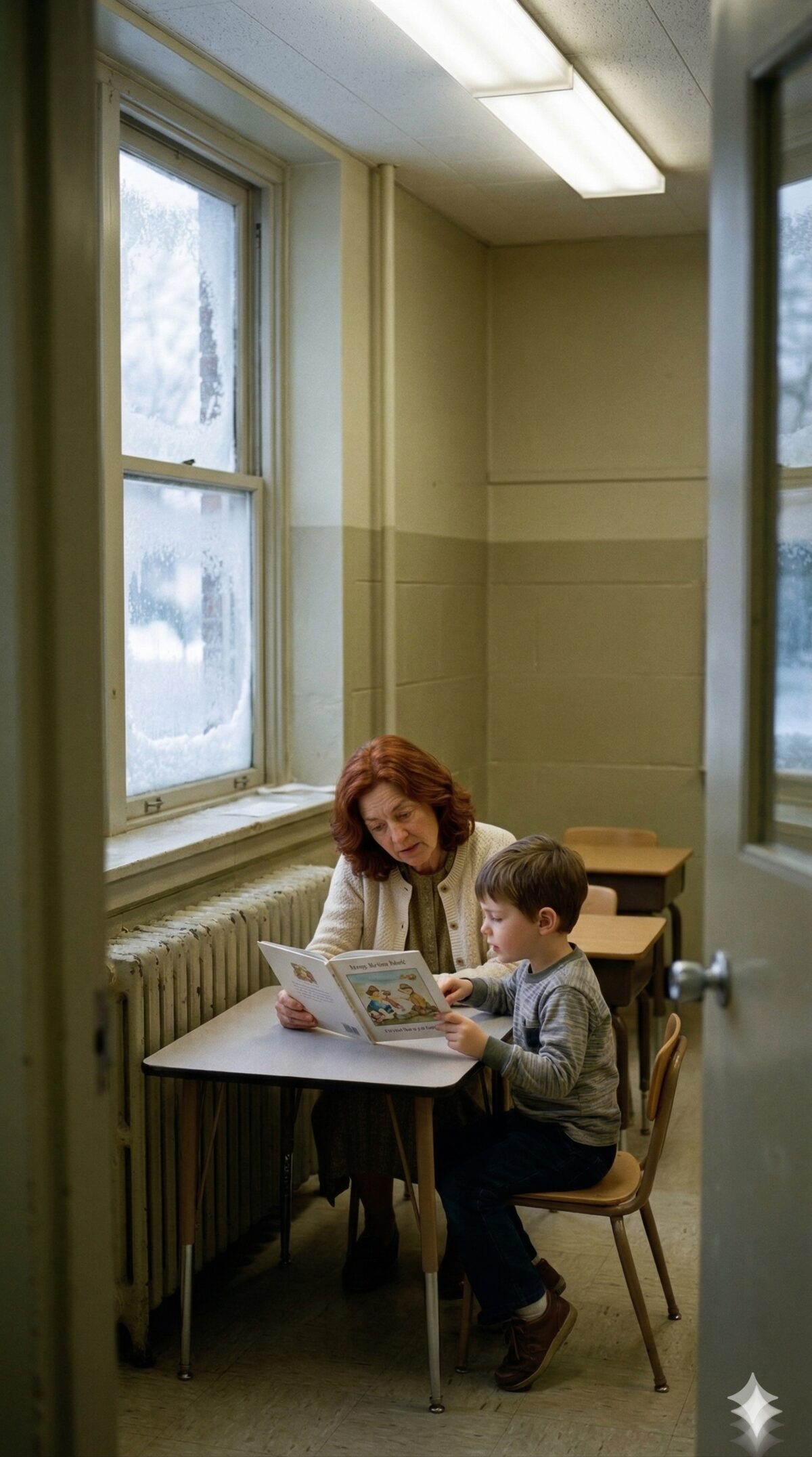
A first-grade classroom with a boy reading
Emerson Elementary, February 1987

Marcus Read a Sentence

1972โ€“2010, Emerson Elementary

Every September, there's a room full of people who can't read, and by June, they can, every year.

I realize everything I've told you so far has been Harold, Harold, Harold. And I, there's other things too. I was a teacher for 38 years. And I haven't even mentioned it. My mother used to say, actually, I'll tell you what my mother used to say another time. It'll take me off track. First grade, 38 years at Emerson Elementary, which is on Stow Street. It's still there. They painted it yellow a few years ago, which I do not approve of. It was red brick and it should have stayed red brick. I started in 1972, the year Sarah was born, which people say, how did you manage a newborn in a classroom? And I say, well, the six-year-olds were easier. This was 72. Eddie Flanagan, who sat behind me in chemistry, came back from Vietnam missing an arm. And here I am teaching six-year-olds to read the word cat. It felt, I don't know if it felt important or if it felt like hiding, maybe both. Harold was home a lot in those years. He'd gone from the lumberyard to, he was doing cabinetry by then, custom work, and he could set his own hours. So he'd have Sarah in this little bouncer in his workshop while he sanded things. She grew up covered in sawdust. She hated it. David loved it, but David came later.

Anyway, 1987. That's the year I want to tell you about. February. There was a boy in my class named Marcus. He was six, very small for his age, barely talked. He had these tiny hands, and he'd hold the book like it was something heavy, like it weighed more than him. The other teachers, and I shouldn't say this but I will, the other teachers had already decided about him. They said learning disability. They said maybe hold him back. This was 87. We didn't have, the testing wasn't what it is now. You just, teachers decided and that was that. But I didn't think so. There was something about the way he watched. He wasn't confused. He was, it was like he was waiting. I can't explain it better than that. He was waiting for something to click.

So I started sitting with him after lunch. Every day, 15 minutes, just me and Marcus and whatever book I thought might work. We started with, oh, what's it called, the one with the brown bear, brown bear, Bill Martin. And for weeks, nothing. He'd look at the pages and look at me, and I'd read and point, and he'd nod. But nothing was happening behind the nod. You could tell. This went on for October, November, December, January. My colleague Diane, Diane Kowalski actually, she was Betty's younger sister, small world. Diane said to me, Maggie, you're wasting your lunch. Just fill out the referral. And I almost did. I almost did one Friday afternoon in January. I had the form on my desk and I thought, one more week.

February 3rd, 1987. I remember the date because there was ice on the windows, this thick frost, and the classroom was cold because the heating was... Emerson always had heating problems. Every winter the principal would send these memos about โ€” that's not important. Marcus and I are sitting at the little table by the window and I've got, I think it was a different book by then, something with a dog. I don't remember the title. And he's looking at the page and I'm about to read it to him like I always do. And he reads it. He reads the sentence out loud. Slowly, one word at a time, his finger under each word, but he reads it. And his face, sorry, this is, it's silly. It was 40 years ago and I'm, his face just opened. That's the only way I can describe it, like a window. He looked up at me and he knew what he'd done. And I knew what he'd done. And neither of us said anything for a second. And then he read it again. And then he turned the page and read the next one.

I went to the teacher's lounge after school and I sat in the chair by the coffee machine and I cried. Diane came in and she thought something terrible had happened and I said, Marcus read a sentence. And she said, Diane was very practical. She said, well good, now you can eat lunch again. People ask me, they used to ask me at parties when they found out what I did. 38 years of first grade, wasn't that boring? And I never knew how to answer that, because it's, how do you explain? Every September, there's a room full of people who can't read, and by June, they can, every year. I saw that happen, what? 800 times, 900. And it never once wasn't, I don't have the word, it just never got old. I don't understand how that could get old.

In the 90s, they started with the standardized testing. And I don't want to get political on this thing, but you cannot test a child into reading. You just can't. I went to a school board meeting in 94. They were cutting the reading specialists, and I stood up and I told the superintendent that if he'd ever sat with a six-year-old for four months waiting for the light to come on, he wouldn't be cutting the people who make it happen. I probably shouldn't have said it like that in front of everybody, but I did. Harold drove me home, and he said, Maggie, I build furniture. And even I know you just scared that man half to death. I said, good. They didn't cut the specialists.

That year, Marcus came to see me at my retirement. 2010. He drove up from, I think he was living in Worcester then, or was it Springfield, somewhere out west out past the Pike. He's a librarian, a librarian. He walked in and I hadn't seen him in, well, 20-some years and he was this tall man with a beard. And I said, Marcus? And he handed me a copy of Brown Bear Brown Bear signed. He'd tracked down Bill Martin at some event and gotten him to sign it. I have it on my shelf next to the photos of the grandkids and that terrible clay thing Jack made me that's supposed to be a cat. He said, Mrs. Brennan, I just wanted you to know. And that was it. He didn't stay long, but that was enough.


Sunflower garden by a fence
Spring 2023

Two Cups by the Window

March 2023, Portland

Your body hasn't gotten the news yet, I think.

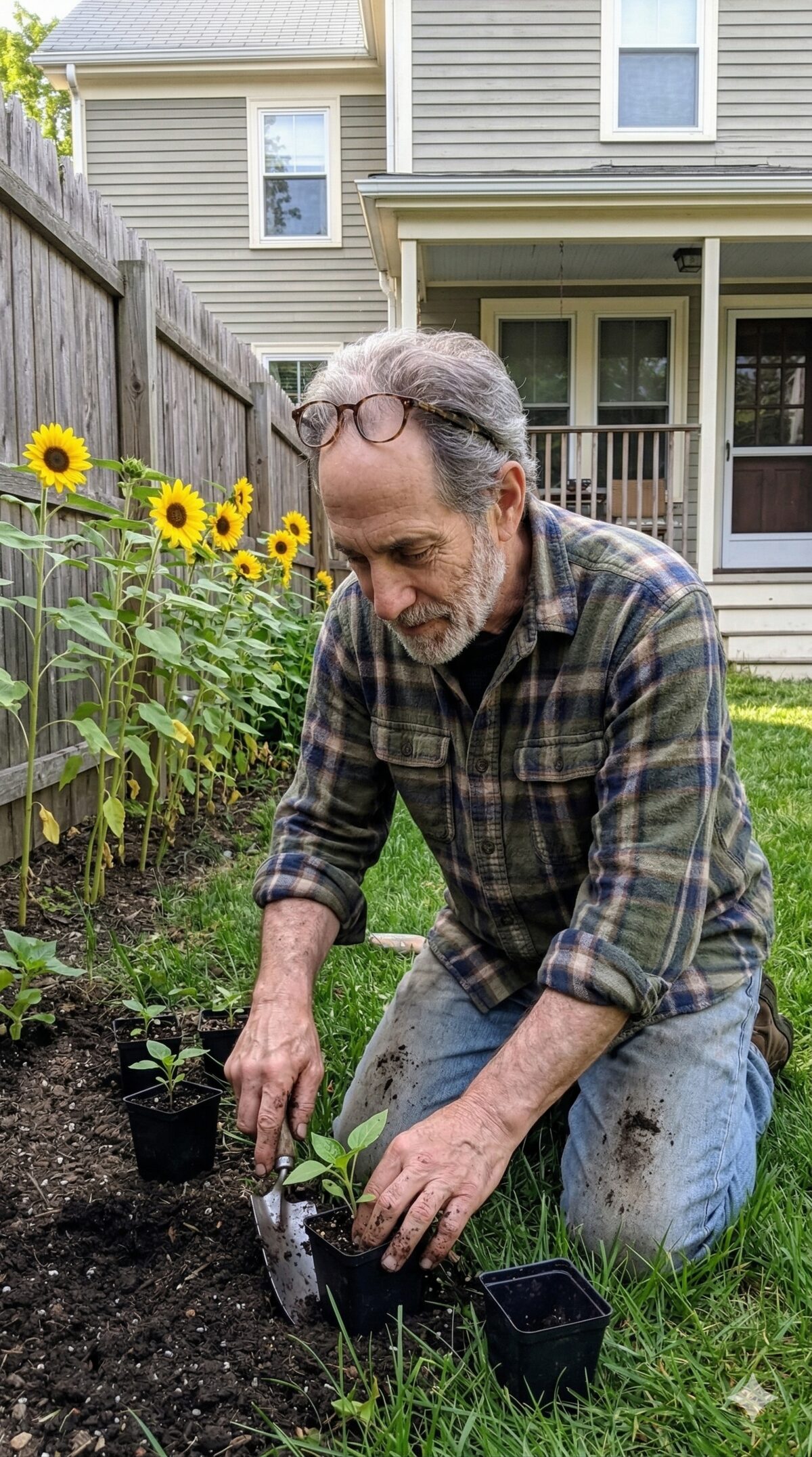
I wasn't going to do this one. I've been putting it off. Sarah said I don't have to, and I know I don't have to, but I think, I think if I don't say it now, I'll just keep not saying it. And then what's the point of any of this? So there are sunflower seeds on my counter right now. I buy them every spring. Harold used to buy them, these giant sunflower seeds, the kind that are supposed to grow six feet tall. And his never did. They'd get to maybe three feet and just stop. And every year he'd say, this is the year. And every year they'd stop at three feet. He had a whole war with these sunflowers.

But I'm getting ahead of myself. Harold died on a Tuesday, March 14th, 2023, which I know it's not that long ago. People say it like it was ages ago. How long has it been? And I say, three years. And they say, oh, that's still fresh. And I want to say, it's not fresh. It's not. It's just how the house is now. It's just how things are. I'm not going to talk about the hospital. I was there and David flew in from Portland and Sarah was there and it was, it was what it was. The doctors were kind. That's all I'll say about that.

I want to talk about Wednesday. I woke up and I reached for him, which I knew. I knew before my hand got there. But your body doesn't. Your body hasn't gotten the news yet, I think. My hand went to his side of the bed, and it was cold and flat, and I just lay there with my hand on his pillow for a while. It still smelled like him, sawdust and that soap he used, the green bar, Irish Spring. The hospital didn't smell like him, and the house did, and I just lay there. His reading glasses are still on the nightstand. I should say that. Three years and they're still there. I dust around them. I don't. I can't pick them up. And I can't put them in a drawer. And I know that Sarah's asked about it. And I say, I'll deal with it. And I don't. They're just there.

I got up, I went downstairs. Sarah had stayed the night. She was on the couch. I could hear her moving around. David had flown back to Portland. Lily was sick. He kept saying, I'm sorry, I'm sorry. And I told him, go, it's fine. Go be with your daughter. It was fine. I mean, it wasn't. But what was he going to do? And I made coffee. Two cups. I took two mugs out of the cabinet. His was the blue one with the lobster on it. We got it at some shop on the Cape in the 90s. The handle was chipped from when David knocked it off the counter. Harold glued it back and you could see the line, but he wouldn't throw it out. And I filled them both and I put his by the window where he always stood. I stood there looking at it. Sarah was in the kitchen and she saw me do it and she didn't say anything. She just sat at the table. I drank mine. I didn't drink his. I poured it out around, I don't know, noon. It was cold by then. I washed the mug and I put it back and the next morning I took out two mugs again. I did that for about a week before I made myself stop.

Nobody tells you how quiet it is. That's the thing I wasn't ready for. The fridge hums and the clock ticks, and that's it. No radio from his workshop. He always had the Red Sox on in there. Even in March, when it's just spring training and nothing matters, he'd listen and yell atโ€” About a month in, I was in the kitchen and I heard the back door, that sound it makes, the hinge that Harold kept saying he'd fix. And I, for about one second, I thought, I turned around and I said, Harold, and it was the wind. The door wasn't even, it was latched. The sound was just the frame shifting. Houses do that. But for one second, for one second everything was normal and then it wasn't.

There were seed packets on the counter. That's what I was. That's why I started with the sunflowers. He'd bought them. It must have been that weekend, Saturday or Sunday. He must have gone to Crosby's while I was at, I don't even know where I was. Tomatoes, basil, and the sunflower seeds. His handwriting on the little labels. He'd already written the labels. Tomatoes, south bed. Sunflowers, along fence. I planted them. I don't know anything about gardening. That was Harold's wholeโ€” I called Frank Peterson from next door. Frank's a Yankees fan, which Harold considered a personal failing, but he's a good man. And I said, Frank, Harold left these seeds. What do I do? And Frank didn't say anything for a minute. And then he said, well, Maggie, let's put them in the ground. He came every Saturday that spring and showed me what to do. The sunflowers grew to four feet that year, tallest they'd ever been. And I know what that sounds like. I'm not going to make it into something it isn't. Harold would have been furious, honestly. He would have said, oh sure, now they grow.

Tommy called that Wednesday morning. I hadn't called anyone yet. I think Sarah must have. I don't know who called Tommy. But he called at 7:30 and he said, Maggie, I'm coming. That's all he said. And he drove four hours from Vermont. He didn't ask if I needed anything. He didn't say he was sorry. He just got in the car. He was there by noon. He sat in Harold's chair and he didn't say much. And I didn't say much. And that was, that was right. That was the right thing. His jacket is still on the hook by the front door, the flannel one, the terrible one from the dance. It doesn't smell like anything anymore. It just smells like the closet. That happened sometime in the first year, and I don't know exactly when. And that bothers me, that I didn't notice the day it stopped. I'm going to stop now.


A handwritten note on yellow paper inside a cookbook
September 2023

Two Lines on Yellow Paper

September 2023

These two lines that have been sitting next to the waffles and the French toast for God knows how long while I was right upstairs.

So something happened. Something happened about six months after Harold died and I haven't told anyone except Sarah. And Sarah cried. And I'm going to tell you now because, I don't know, it feels like it's time. I was going to try the pancakes again. This was September, maybe, 2023. The kids were coming for David's birthday. David and the girls were flying in and I thought, I'll try again. I'll make the pancakes. It'll be nice. It was a terrible idea, but I didn't know that yet.

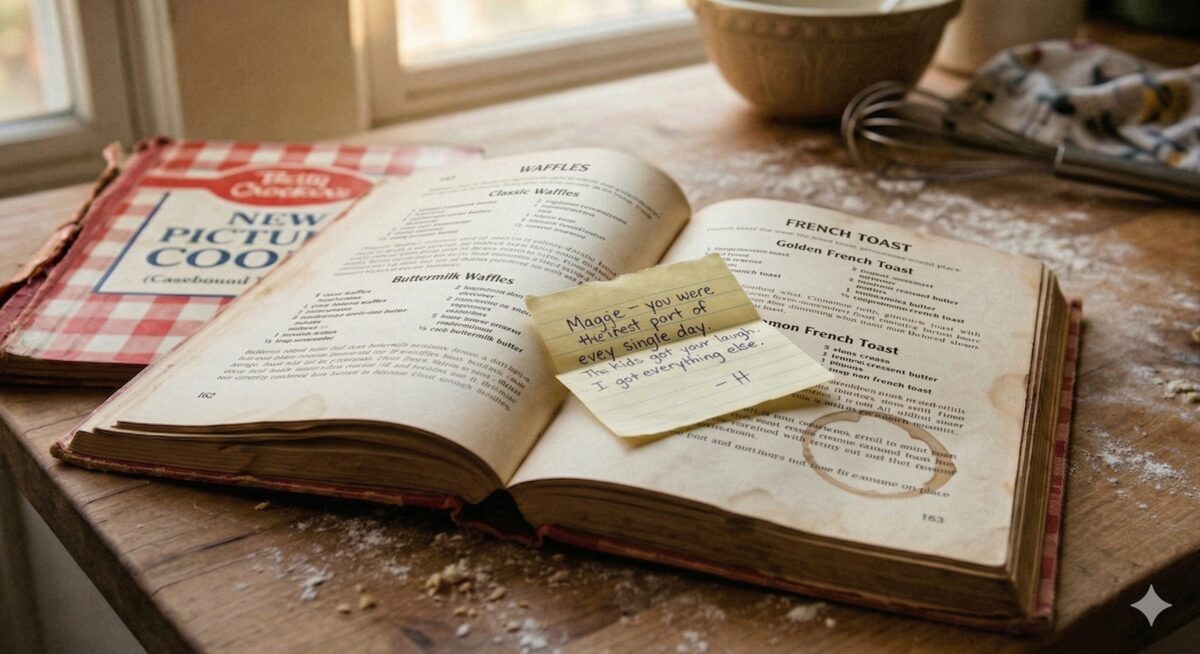
So I'm looking for the recipe, which I know, I told you there's no recipe. Harold never wrote it down. But I thought maybe Grace had, somewhere, years ago. Grace had this cookbook, this old Betty Crocker from 1960 something. Red and white one, you know the one. The pages are yellow, and there's a stain on the pot roast page from, I think, from the Carter administration. Harold kept it after Grace died. It was in the kitchen cabinet behind the flour. I don't think he ever opened it. He didn't need a cookbook. He just, you know. But I thought maybe she'd written the pancake recipe in the margins or on one of those index cards people used to tuck in.

So I pull it out and I'm flipping through. And there are Grace's notes. She wrote in this tiny handwriting little things like, more salt next to the meatloaf. Tom likes this next to the chicken. Tom was Harold's father. He died before I met Harold. I only know him from photos. He looked just like David, actually. Same jaw. Anyway, I'm flipping through and I get to the breakfast section and something falls out. A piece of paper folded in half. Yellow legal pad paper, the kind Harold used for everything. His lumber orders, his measurements, his grocery lists, everything went on yellow legal pad paper. And it's his handwriting, not Grace's, Harold's. I read it and I didn't understand it. I mean, I read the words, but they didn't, I read it again. And my hands were, I had to put it down on the counter because my hands were shaking and I couldn't, sorry, give me a second.

It said, Maggie, you were the best part of every single day. The kids got your laugh. I got everything else. H. That's it. Two lines on a piece of yellow paper tucked inside his mother's cookbook. I don't know when he wrote it. That's the thing that I keep turning that over. The handwriting wasn't shaky, so it wasn't the last few years. His hands had the arthritis by then. So it was before that. Could be 10 years ago, could be 20. He wrote this at some point and put it in the one book he knew I'd never look in while he was alive, because I never cooked from Grace's book. That was his territory. And did he know? Did he think about me standing in the kitchen finding it after he was gone? Did he plan it that way? Or did he just write it one afternoon and tuck it in and forget? I'll never know. That's I'll never know and I think about it all the time.

Harold was not a talker. I need you to understand that. He was a kind man and a patient man, and he loved me. I knew that. I always knew that. But he didn't say things like this. In 52 years, I can count on one hand the times he'd show it. He'd make the pancakes, and he'd fix the hinge, and he'd drive to the store at 10 at night if I wanted ice cream. But he didn't. He wasn't a words man. And then this. These two lines that have been sitting next to the waffles and the French toast for God knows how long while I was right upstairs.

I sat on the kitchen floor. I didn't make it to a chair. I just slid down the cabinet and I held this piece of paper and I said out loud, to the kitchen, to nobody, I said, Harold, youโ€” and I couldn't finish. I don't know what I was going to say. I talk to him sometimes, at the kitchen table mostly. I'll say, Harold, the sunflowers are up. Or, Harold, Jack made the baseball team. Just small things. And it's not sad when I do it, it's just he's part of the house still. But this time I couldn't get past his name. Sarah called a few hours later just checking in, and I told her. And she started crying, and I started again, and we were just two women crying on the phone about a piece of yellow paper.

I put it back. I put it back in the cookbook, same page, folded the same way. I don't know why. It felt like it belonged there. Like if I moved it somewhere safer, it would lose something. I never did make the pancakes that weekend. We ordered pizza. David said it was better anyway. The kids got your laugh. Harold wrote that. And he's right. Sarah does laugh like me. I'd never noticed until he pointed it out on a piece of legal pad paper from inside a cookbook. I don't have a way to end this one. I just wanted you to know it happened.


Maggie at home, age 78
Concord, 2026

When I Can't Remember, You Can

present, with 1963 flashback, Boston

I want to get it down while it's all still here, so that when I can't remember, you can.

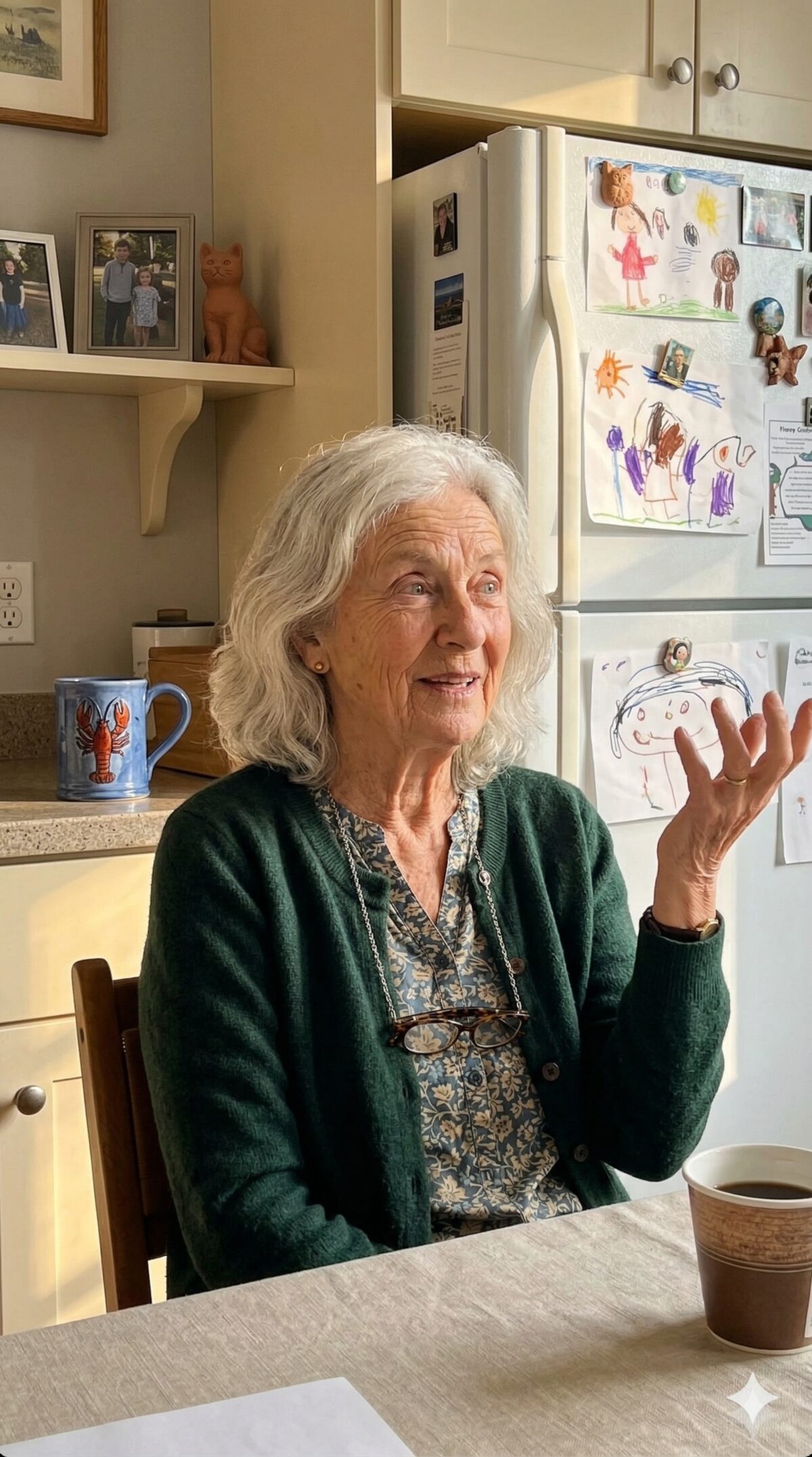
This one's for you kids, Emma, Jack, Lily, Sam. I know you probably won't listen to these for a while. Maybe not until you're older, and that's fine, that's fine. But I wanted to say some things while I โ€” I forget things now, I know I do. I told the Snowfort story twice at Thanksgiving, and nobody said anything, but I could see Sarah's face. And last week, I called Jack Tommy. And then I called him Harold. And he just said, it's Jack, Grandma. And I knew that. I knew that. But the names, they swim around now. So that's why I'm doing this. I want to get it down while it's all still here, so that when I can't remember, you can.

I want to tell you something about my mother. I kept mentioning her and not finishing. She had this saying. She'd say, Margaret, the extraordinary things are the ordinary things. And I thought that was the dumbest thing I'd ever heard. I was 15, Joan Baez was playing in Boston, '63 I think, and I wanted to go and my mother said no. And I said my life is boring and nothing happens here. And she said that, the extraordinary and the ordinary. And I rolled my eyes so hard, I'm surprised they came back.

And it took me most of my life to โ€” I don't know how to say it without sounding like a greeting card. I'm not going to try. You've heard my stories. You know what I mean.

Jack, you're so much like your grandfather, it scares me sometimes. You don't talk much, and you notice everything. Don't wait 52 years to write it down. Whatever you're thinking about that girl in your math class โ€” yeah, your mother told me, don't be mad at her โ€” say it or write it on a piece of yellow paper. Just don't put it in a cookbook.

Emma, you're 17 and you want to change the world. And I believe you. I do. Just don't forget to eat breakfast. I'm serious. The world can wait until after breakfast.

And Lily and Sam, you're 10 and seven and you won't understand most of this for a long time and that's okay. That's how it should be. Just come visit me. Come visit me and we'll make pancakes. David's recipe now with the music. They're getting better.

Take care of each other. That's really the only thing I know for sure. Take care of each other and call your mothers. And if someone asks you to dance and they're wearing a terrible shirt โ€” sorry, I thought I could get through this one without. Okay, I think that's everything I wanted to say. Harold would say, Maggie, the grocery store, six towns. He'd say I took the long way to say something simple. He's probably right. There it is.